

Everyone talks about AI in accounting.
But in most finance teams, month-end close still looks the same.
ERP for storage.
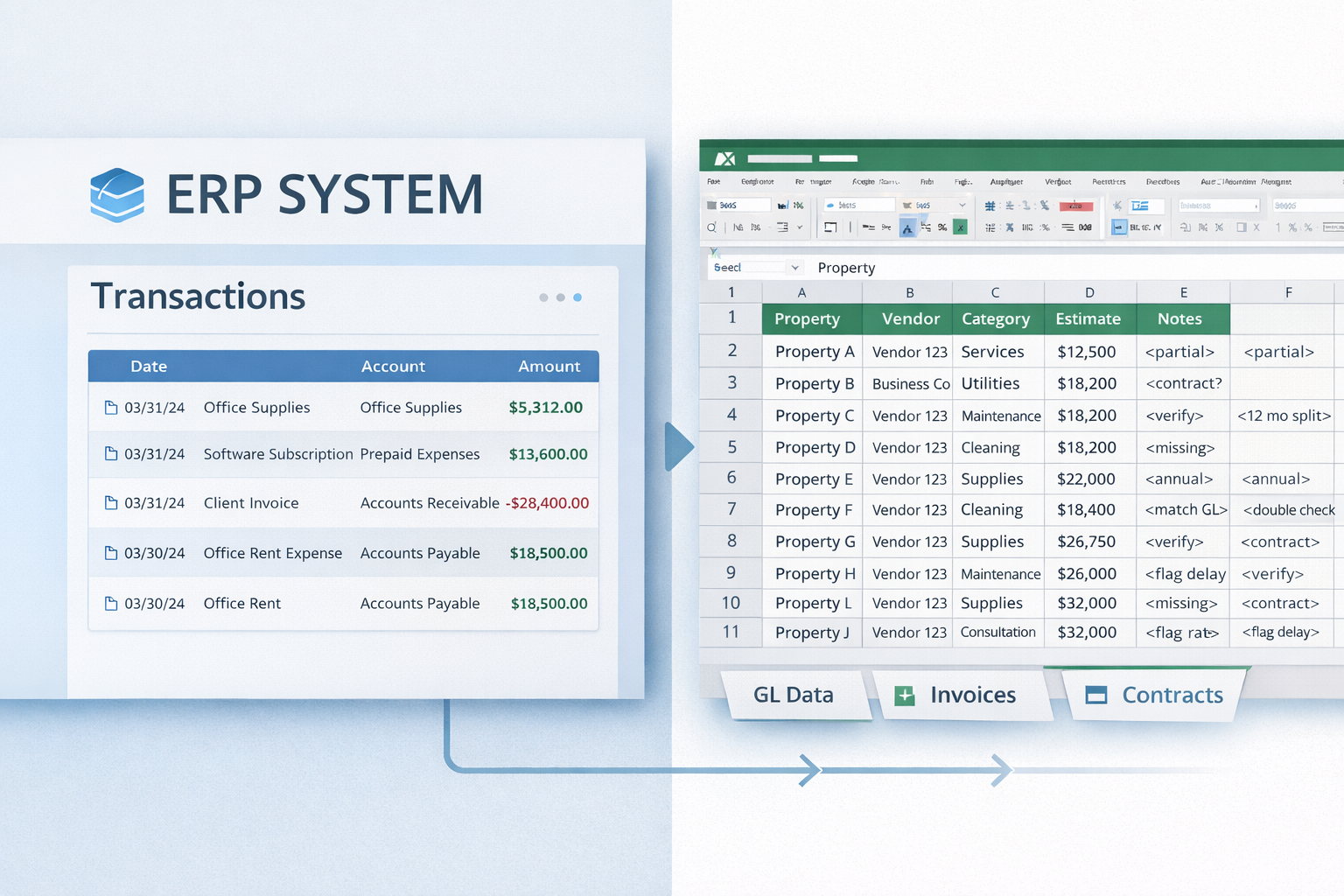
Excel for actual work.
That hasn’t changed.
On paper, the ERP is the system of record.
In practice, it’s not where the work happens.
The actual workflow looks like this:
Data is pulled from the ERP.
Logic is built in Excel.
Adjustments are calculated manually.
Results are pushed back into the ERP.
The ERP stores the data.
Excel runs the process.
Where the Work Actually Happens
Take a simple accrual.
The invoice hasn’t arrived yet, so the accountant checks last month’s expense, looks at the contract, estimates the amount, writes it in Excel, and posts a manual entry.
Or take a basic reconciliation.
The GL doesn’t match the bank, so someone exports both, compares line by line, filters duplicates, and manually figures out what’s missing.
This is where the real work is.
Not in dashboards.
Not in queries.
In stitching together incomplete data and turning it into something usable.
Why This Hasn’t Changed
Even with the rise of AI tools, this hasn’t changed.
Most of them are still designed around the ERP layer.
They summarize data.
They answer questions.
They flag anomalies.
But they don’t enter the execution layer.
They don’t calculate accruals.
They don’t reconcile across systems.
They don’t produce journal entries.
They observe the process.
They don’t run it.
That’s the real gap.
There is no system that can pull multiple data sources together, apply accounting logic across them, handle incomplete or inconsistent inputs, and produce outputs like journal entries and supporting documentation.
So teams build it themselves.
Every month.
In Excel.
That’s why month-end close still lives in Excel.
And that’s the layer we’re building at Verfi, not another way to look at financial data, but a system that actually runs the work.